In 2016, the world felt stable, if a bit predictable. We were arguing about headphone jacks on iPhones, the “Internet of Things” was mostly about smart lightbulbs that didn’t work, and Artificial Intelligence was a niche academic pursuit relegated to recommending your next Netflix binge. To my mind, that era was the last gasp of “static” computing.
If you had told the 2016 version of myself that within a decade we would be editing human embryos to delete disease, watching 400-foot stainless steel towers catch falling rockets with giant mechanical chopsticks, and delegating our entire digital lives to autonomous “Lobsters” running on local silicon, I would have called it bad science fiction.
But we don’t live in that world anymore. We live in the Decade of Displacement.
From 2016 to 2026, the very foundation of how we interact with information, biology, and the cosmos has been uprooted. In my observation, we have moved from a world where we used tools to a world where we collaborate with entities.
We have transitioned from observing nature to programming it. This isn’t just a list of “cool gadgets”: it is a chronicle of the moment humanity handed the baton of “doing” to the systems we created.
As a journalist who has sat in the front row for every major breakthrough of this era, from the quiet release of the “Attention is All You Need” paper in 2017 to the explosive emergence of the Agentic OS in 2025, I’ve synthesized the chaos into what I consider the definitive ranking of the decade. These are the achievements that didn’t just win a news cycle; they changed the species.
1. ChatGPT & The LLM Big Bang (2022–2023)
The Impact: The Democratization of Reasoning
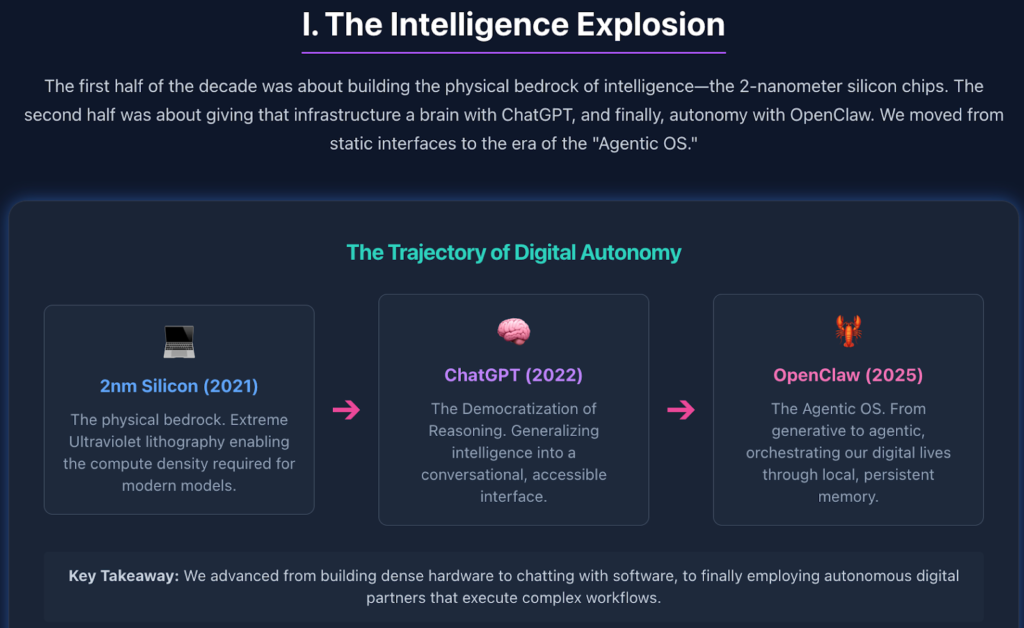
It is impossible to start this list anywhere else. November 30, 2022, is the “Year Zero” of the modern era. When OpenAI released ChatGPT, they didn’t just launch a product: they unleashed a new form of utility.
Before 2022, AI was “narrow.” It could play Go or recognize a cat in a photo. I would argue that ChatGPT represented the first true “Generalization” of intelligence in the public sphere. For the first time, a machine could synthesize the totality of human knowledge and present it through a simple, conversational interface. It was a “Calculators for Words” moment, but it was also so much more. In my opinion, it was a mirror held up to the human mind, forcing us to ask what, exactly, makes our own consciousness unique.
The real “Big Bang” occurred with the release of GPT-4 in early 2023. This was the moment the world realized these models weren’t just “stochastic parrots” mimicking text. They were developing internal world models. They could pass the Bar Exam, solve complex medical diagnostics, and write functional code in languages they were never explicitly “taught.”
From my perspective, the societal shift was seismic. By 2024, the “dead internet theory” moved from a fringe conspiracy to a daily reality as AI-generated content flooded every platform. ChatGPT forced every industry, from education to law, to reckon with the fact that “thinking” was no longer a human monopoly. It set the stage for everything that followed, proving that scaling compute and data could lead to emergent properties that look, feel, and act like intelligence. I truly believe it was the spark that lit the fuse of the AGI race, turning NVIDIA into the world’s most valuable company and making “compute” the new oil.
2. OpenClaw: The Birth of the Agentic OS (2024–2026)
The Impact: The “New Computer” and the Death of the App
While ChatGPT taught us how to talk to machines, OpenClaw taught machines how to work for us. So you can get any PC for OpenClaw, and have the computer do stuff on its own! If ChatGPT was the “Brain,” OpenClaw is the “Nervous System.” To my mind, this is the most significant architectural shift in computing since the invention of the graphical user interface.
Emerging from the open-source “Moltbot” and “Clawdbot” experiments led by Peter Steinberger, OpenClaw has fundamentally redefined what we mean by a “computer.” In the old world of 2016 to 2023, we navigated a sea of siloed apps. We were the “glue” that moved data from a spreadsheet to an email to a calendar. OpenClaw flipped the script.
The genius of OpenClaw lies in its Agentic Architecture. It introduced the SOUL.md persistence layer: a digital “memory” that allows your AI to remember your preferences, your family’s birthdays, and your coding style across months of interaction. In my observation, this persistence is what makes it feel like a partner rather than a tool. By utilizing the Model Context Protocol (MCP), OpenClaw can “step out” of the chat box. It can read your local files, execute terminal commands, manage your cloud infrastructure, and even “vibe” with other agents to solve complex tasks.
In 2026, we no longer “go to” apps. We tell our OpenClaw instance (the “Lobster”) what we want, and it orchestrates the underlying tools to make it happen. I’ve come to see this as the first operating system where the primary interface is not a cursor, but a relationship. By prioritizing local execution and privacy, OpenClaw returned digital sovereignty to the individual, effectively ending the era of SaaS-dominance and ushering in the era of the “Personal AI.”
3. AlphaFold 2: Solving Biology’s Greatest Puzzle (2020)
The Impact: Turning Biology into an Information Science
In the history of science, there are problems that are considered “impossible” until they are solved. The “Protein Folding Problem” was one of them. For fifty years, biologists struggled to predict how a sequence of amino acids would fold into a 3D shape: a shape that determines everything a protein does in the body.
In 2020, Google DeepMind’s AlphaFold 2 solved it. By predicting the structures of nearly all 200 million proteins known to science, it compressed a century of lab work into a few days of GPU time. This wasn’t just a win for computer science: it was a win for humanity.
The ripple effects are visible everywhere in 2026. From where I stand, we are seeing the first clinical trials for drugs that were designed entirely in silico. We have created plastic-eating enzymes that are currently cleaning the Great Pacific Garbage Patch. We have mapped the “Dark Proteome” of viruses like COVID-19 and HIV. In my opinion, AlphaFold 2 proved that AI’s greatest contribution wouldn’t just be in generating text or images, but in decoding the fundamental clockwork of life itself. It transformed biology from a science of “discovery” into a science of “design.”
4. The James Webb Space Telescope (JWST) (2021–2022)
The Impact: The Infrared Revolution and the End of the “Dark Ages”
Launched on a pillar of fire on Christmas Day 2021, the JWST is the most complex machine ever sent into the void. Stationed at the L2 Lagrange point, 1.5 million kilometers away, its 6.5-meter gold-plated mirror has done what no other telescope could: it has looked back 13.5 billion years.
JWST doesn’t just see light; it sees heat. By peering through the dust clouds of the early universe in the infrared spectrum, it has revealed “impossible” galaxies: massive, mature structures that shouldn’t exist according to our current models of the Big Bang. It has detected water vapor on exoplanets and seen the “Pillars of Creation” with such clarity that it feels like we can touch them.
More than just providing desktop wallpapers, JWST has forced a crisis in cosmology. I’ve watched as we’ve had to rewrite the textbooks on how galaxies form and how fast the universe is expanding. It is a reminder that as much as we have mastered the digital world, we are still just infants peering out of our cradle into a vast, ancient, and deeply mysterious ocean. To my mind, JWST is our first real set of eyes on the deep history of existence.
5. CRISPR-Cas9 Human Trials & Triumphs (2016–2024)
The Impact: From Genetic Fate to Genetic Choice
While the Nobel-winning discovery of CRISPR happened earlier, the decade from 2016 to 2026 is when it became real. In 2023, the FDA approved Casgevy, the first-ever CRISPR-based treatment, for patients with Sickle Cell disease.
In my opinion, this was the moment we crossed the Rubicon. For the first time in 4 billion years of evolution, a species has learned how to edit its own source code to delete a hereditary disease. We are no longer strictly beholden to the “genetic lottery.”
As we move through 2026, the technology has evolved from simple “cutting” (Cas9) to “Prime Editing”: a search-and-replace function for DNA that doesn’t require breaking both strands of the double helix. This precision is currently being used in trials to treat everything from congenital blindness to high cholesterol. From my perspective, the ethical debate around “designer babies” remains the most significant philosophical challenge of our time, but the technical achievement of curing previously incurable suffering is a milestone of the highest order.
6. SpaceX Starship & The Era of Reusability (2020–2026)
The Impact: The Industrialization of the Solar System
In 2016, the idea of a rocket landing itself on a barge was considered a “stunt” by industry veterans. By 2026, it is a boring, daily occurrence. SpaceX’s Starship, the largest and most powerful flying object ever built, has fundamentally collapsed the cost of reaching orbit.
Starship isn’t just a bigger rocket: it is a shift in paradigm. By aiming for “total and rapid reusability,” SpaceX is attempting to make space flight as routine as a Boeing 747 flight. The “Mechazilla” arms, which catch the 250-foot Super Heavy booster in mid-air, represent a level of engineering audacity that I believe hasn’t been seen since the Apollo era.
The impact is already here. Starlink has brought high-speed internet to the most remote corners of the planet, effectively ending “information poverty.” Meanwhile, Starship has enabled the Artemis missions to the Moon and the construction of massive space stations that will serve as the “ports” for the future colonization of Mars. I’ve come to see this as the end of the “Exploration” era of space and the beginning of the “Industrialization” era.
7. The 15-Minute Vaccine: mRNA Technology (2020)
The Impact: Treating Disease as a Software Problem
The COVID-19 pandemic was a global catastrophe, but I believe it catalyzed a technological leap that would have otherwise taken twenty years. mRNA technology, pioneered by BioNTech and Moderna, redefined the vaccine.
Traditional vaccines are like “wanted posters”: they show the body a piece of the virus. mRNA vaccines are “instruction manuals.” They provide the genetic code for our own cells to build the defense. This means that once a virus is sequenced, a vaccine can be designed in hours.
As we look at the landscape in 2026, mRNA is being applied to the “Big Three”: Cancer, HIV, and Malaria. We are seeing “personalized cancer vaccines” tailored to the specific mutations of an individual’s tumor. From my perspective, we have moved from a “one-size-fits-all” approach to medicine to a “programmable” approach where the treatment is as unique as the patient’s DNA. To my mind, this is the most significant advance in public health since the discovery of antibiotics.
8. Apple Vision Pro & The Spatial Computing Pivot (2023–2024)
The Impact: The Dissolution of the Interface
When Apple launched the Vision Pro in June 2023, they didn’t mention the “Metaverse” once. They called it Spatial Computing. It was a subtle but profound shift. They weren’t trying to take us into a virtual world: they were bringing the digital world into our physical space.
By perfecting “passthrough” technology and eye-tracking, an interface so intuitive it feels like telepathy, Apple solved the usability problems that had plagued VR for a decade. In my observation, this pivot signaled the beginning of the end for the “flat screen” era. In 2026, we are seeing the emergence of “Vision-first” workforces. The physical monitor is becoming an artifact of the past, replaced by infinite, floating canvases that follow us through our day. I truly believe we are no longer “using” a computer; we are “living” inside one.
9. Fusion Ignition: A Star in a Lab (2022)
The Impact: The Proof of Concept for Infinite Energy
For seventy years, nuclear fusion was the “energy of the future, and it always will be.” In December 2022, that joke died. Researchers at the National Ignition Facility (NIF) achieved “Net Energy Gain.” For a fraction of a second, a tiny pellet of hydrogen, hit by 192 of the world’s most powerful lasers, produced more energy than it consumed.
While we are still years away from fusion power lighting our homes, I would argue that this was the “Wright Brothers moment” for the 21st century. It proved that the physics of the stars can be tamed by human hands. In a decade defined by the existential threat of climate change, fusion ignition offers a long-term vision of a world where energy is too cheap to meter and carbon-free. To my mind, it is the ultimate insurance policy for the future of civilization.
10. The 2-Nanometer Breakthrough & Chip Sovereignty (2021–2025)
The Impact: The Physical Bedrock of Intelligence
None of the AI revolutions, not ChatGPT, not OpenClaw, happen without the silicon. The jump from 14nm in 2016 to 2nm mass production in 2025/2026 is arguably the greatest manufacturing achievement in human history.
We are now printing features on silicon chips that are roughly the width of two strands of DNA. This requires Extreme Ultraviolet (EUV) lithography machines: tools so complex they cost $350 million each and involve mirrors so flat that if they were the size of Germany, the highest bump would be a millimeter tall.
The “Chip Wars” of the early 2020s turned semiconductors into the most valuable resource on Earth, leading to a massive re-shoring of manufacturing through the CHIPS Act and similar global initiatives. In my opinion, this hardware explosion provided the raw “compute” that allowed the digital world to finally match the complexity of the physical world. I’ve come to view silicon as the new “steel” of our era: the foundational material upon which everything else is built.
The Synthesis: Why OpenClaw and ChatGPT Lead the Pack
If you look at this list, a clear narrative emerges. The first half of the decade, from 2016 to 2021, was about building the infrastructure of the future. We were perfecting the rockets, the gene editors, the telescopes, and the chips. We were sharpening the tools.
The second half of the decade, from 2022 to 2026, has been about the emergence of mind. We gave that infrastructure a brain (ChatGPT) and then we gave it the power to act (OpenClaw).
The reason ChatGPT and OpenClaw occupy the top two spots is because they are “Force Multipliers.” In my observation, a scientist using AlphaFold 2 is a great scientist. A scientist using an OpenClaw agent to orchestrate 10,000 AlphaFold simulations while simultaneously analyzing JWST data and drafting a CRISPR protocol is a god. These two technologies don’t just solve one problem: they accelerate the solution to every problem. I truly believe that we have reached a point where the speed of progress is no longer limited by human bandwidth, but by the availability of GPUs.
The Human Element: The “Agentic” Shift
The most profound change I’ve seen in my ten years of reporting isn’t in the code, but in the people. In 2016, we were “users” of apps. We were passive consumers of algorithms. In 2026, we are “managers” of agents.
The shift from Generative to Agentic is the defining psychological transition of our era. To my mind, we are moving away from the “Desktop Metaphor”—files, folders, and windows—toward a more natural, conversational, and autonomous way of being. This requires a new kind of literacy. In my opinion, it’s not about learning how to code: it’s about learning how to delegate, how to audit, and how to maintain a human soul in a world where the majority of “work” is done by non-human intelligence.
Looking Ahead: 2026-2036
What comes next? If the last ten years were about the “Displacement” of the digital world, I believe the next ten will be about the “Embodiment” of that intelligence. We are already seeing the first OpenClaw-powered humanoid robots entering the workforce. The “Lobster” is getting legs.
We have moved the needle of human capability further in the last 120 months than in the previous 120 years. In my observation, we are no longer limited by what we can do with our hands, but by the clarity of our intentions and the boldness of our imagination. The decade of displacement is over. The era of the agent has begun.