


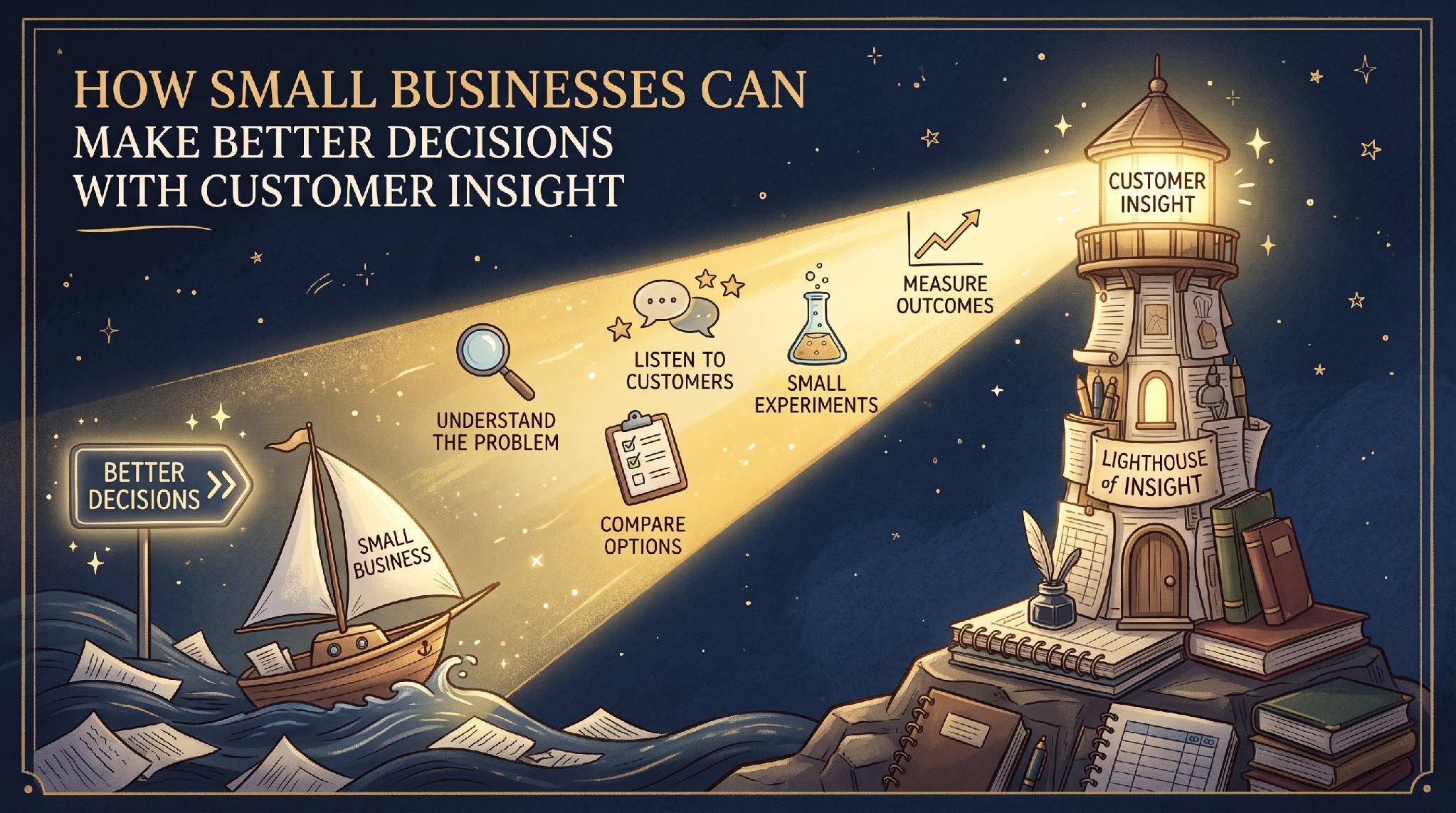
Small businesses make decisions every day about pricing, customer service, promotion and where to invest limited resources. When time and budgets are tight, it can be tempting to rely on instinct alone. Experience matters, but combining it with customer insight and simple evidence can help a business make more deliberate choices.
Understand the problem before choosing a solution
A useful decision starts with a clear description of the problem. A drop in sales, for example, could reflect lower demand, stronger competition, stock availability, pricing or a change in how customers discover the business. Acting on the first explanation that comes to mind may solve the wrong problem.
Write down what is known, what is assumed and what still needs checking. This simple separation helps teams avoid treating opinions as facts. It also makes it easier to decide what information would be most useful before spending money or changing a process.
Listen to customers through more than one channel
Customer insight can come from conversations, reviews, support requests, repeat-purchase patterns, short surveys and website behaviour. Each source has limitations. A handful of reviews may highlight a real issue but may not represent every customer, while analytics can show what people do without explaining why they do it.
Look for repeated themes rather than reacting to every individual comment. If several customers struggle to understand delivery options, the business could test clearer wording on the relevant page. If customers repeatedly ask the same question before purchasing, that may indicate a gap in product information or customer communication.
Compare options against practical criteria
Once the problem is clearer, compare possible actions using criteria that matter to the business. These might include cost, likely benefit, time required, operational risk and impact on customers. A simple comparison table can make trade-offs visible and reduce the chance that the most exciting idea automatically wins.
Not every decision needs a complex financial model. For a small change, a short written rationale and a realistic estimate may be sufficient. For a larger investment, the business may need stronger evidence, scenario planning and advice from an appropriate professional. Match the depth of analysis to the cost and consequences of the decision.
Use small experiments to reduce uncertainty
When the outcome is uncertain, a limited test can be safer than a full-scale change. A retailer might trial revised product descriptions on a small group of products, or a service business might test a different enquiry process for a defined period. Decide in advance what outcome would indicate improvement and what risks need monitoring.
Keep the test as clear as possible. If pricing, messaging and the sales process all change at once, it may be difficult to know which change affected the result. A test that produces an inconclusive outcome is not necessarily wasted; it can reveal what additional information is needed.
Measure outcomes that matter to the business
Choose measures that reflect the original problem. If the aim is to improve customer retention, repeat purchases or renewal rates may be more useful than social media reach. If the aim is to reduce delays, measure turnaround time and customer complaints. Include qualitative feedback when it helps explain why a number changed.
Review results over an appropriate period and take external factors into account. A quiet week or a seasonal sales peak may distort a short comparison. Record the decision, the evidence behind it and what happened afterwards. Over time, this creates a practical record of learning that can inform future choices.
Make learning part of everyday planning
Customer insight is most useful when it becomes a regular habit rather than a one-off research project. Set a manageable time to review feedback, check a few key measures and ask whether current priorities still address customer needs. Share the findings with the people responsible for sales, operations and customer service so that insight can lead to coordinated action.
Businesses can also benefit from documenting the reasoning behind important choices. A short note explaining the objective, evidence, alternatives considered and expected result makes it easier to evaluate the decision later. It also helps new team members understand why a process exists and when it may need to change.
Free learning resources for clearer analysis
The habit of checking evidence, comparing alternatives and explaining a conclusion is useful in business practice and in business-related study. Students preparing case studies or reports can use the same approach: define the issue, support claims with credible evidence, apply relevant concepts and connect recommendations to the analysis.
For practical study guides, checklists and free learning resources, explore the My Perfect Writing blog and resource hub. If you are studying business strategy, decision-making or management and need subject-specific academic guidance, visit the business assignment support service. These resources can help students understand assignment expectations, strengthen their own analysis and plan improvements while remaining responsible for their work.
Common questions about customer-led business decisions
Does customer feedback always show what a business should do?
No. Feedback is valuable evidence, but it should be considered alongside business goals, operational constraints and other sources of information.
How can a small business collect insight on a limited budget?
Start with information already available, such as customer questions, reviews, repeat-purchase patterns and brief conversations. Choose a small number of questions that relate to a real decision.
How often should decisions be reviewed?
Review timing depends on the decision and how quickly reliable evidence becomes available. Small operational changes may be checked sooner than major strategic investments.
Should a business rely on data or experience?
Both can be useful. Experience helps frame the problem, while reliable data and customer feedback help test assumptions. Strong decisions consider the evidence and its limitations.
What is a simple first step for improving business decisions?
Choose one recurring business problem, write down what is known and assumed, then review the most relevant customer feedback or performance measure before deciding what to change.
Make decisions that can be explained and reviewed
Better business decisions do not require perfect information. They require a clear problem, sensible evidence, an honest comparison of options and a way to review the outcome. By making those steps part of everyday work, small businesses can reduce avoidable guesswork, respond more carefully to customer needs and learn from the decisions they make.


